Why your website needs a story, not just a portfolio
Most websites tell you what a business sells. Very few tell you why it exists. That gap is where most visitors quietly leave — and it’s the gap a story-led website is built to close.
Before I designed websites, I studied microbiology. It sounds like a strange route into web design, but the habit it left me with is the one I use most: look closer. Under a microscope, the interesting part is never on the surface. Brands are the same.
Open ten websites in the same industry and you’ll see the same thing ten times. A hero image, a list of services, a few testimonials, a contact form. All perfectly fine. All instantly forgettable. Nobody chooses a designer, a hotel or a painter because their contact form was nice.
People choose the one they understood. The one that made them feel something. That’s what I mean by a story.
What a story-led website actually is
A story-led website is not a long About page. It’s not a founder’s biography in four paragraphs, and it’s definitely not a slogan in a big font.
It’s a website where every section answers the question a visitor has at that moment, in the order they have it. Who is this? Why should I care? Can I trust them? What happens if I get in touch? When a site answers those in the right order, it doesn’t feel like a sales pitch. It feels like a conversation.
The story is the thread that holds those answers together. It decides what goes first, what gets cut, which image leads, and even how the page moves.
Why a story works better than a list of features
Features are easy to compare, and anything that’s easy to compare ends up being compared on price. A story is much harder to compare, because it only belongs to you.
There’s a second reason. People remember reasons far better than they remember facts. Tell someone your studio offers “bespoke, high-quality design” and it’s gone in a second. Tell them you started because you couldn’t stand watching good work hidden behind bad websites, and they’ll repeat it to a friend.
And a story builds trust before anyone has spoken to you. When the design, the words and the structure all say the same thing, a visitor stops checking whether you’re legitimate and starts imagining working with you.
The four layers I work through
Every project I take on goes through the same four layers. They’re simple, but skipping any one of them is usually where websites go wrong.
1. Surface — what you sell
Start with what’s already obvious: products, prices, services. It matters, but it’s only the surface. If your website stops here, you’re competing with everyone else who sells the same thing.
2. Story — why you exist
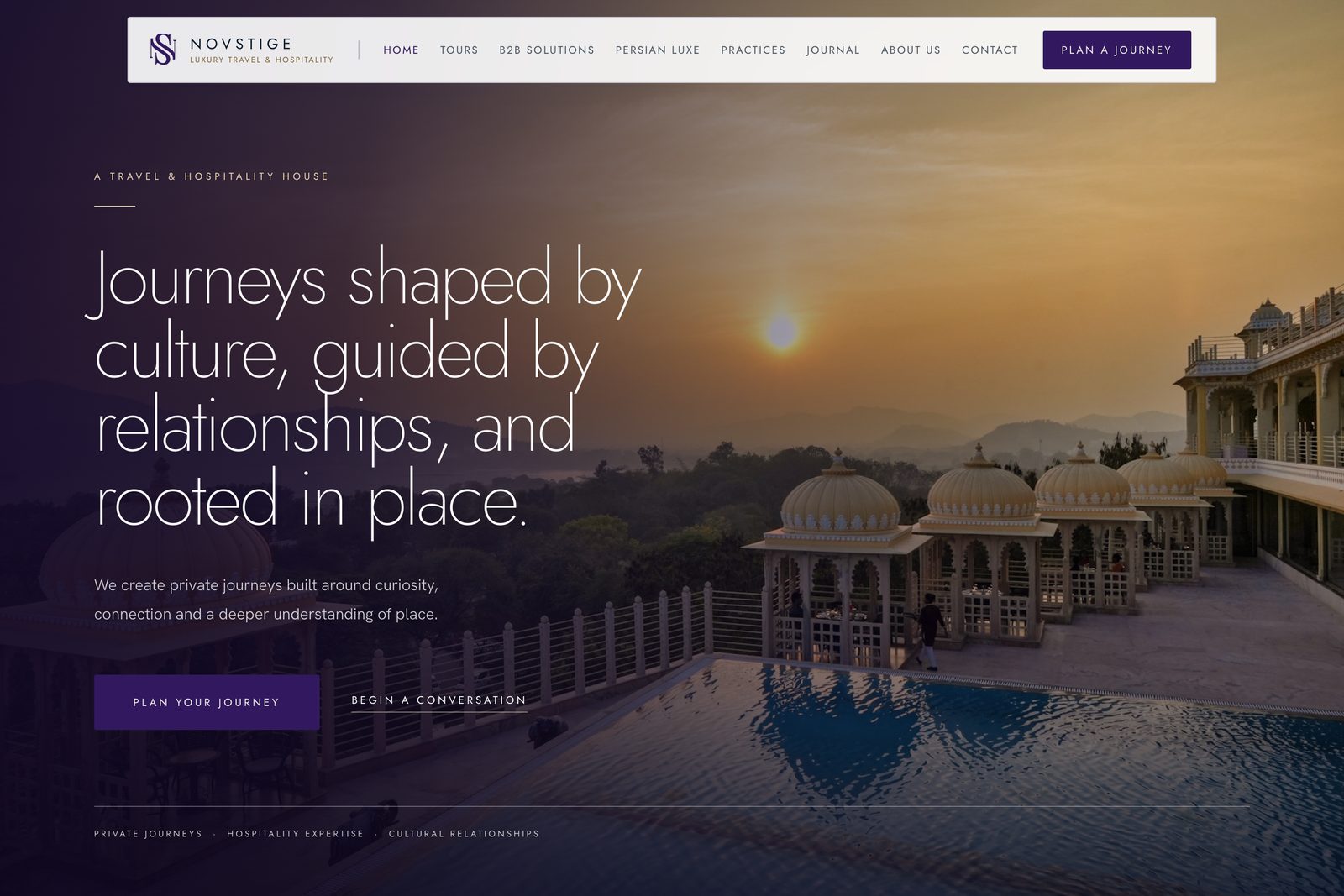
This is the part most brands skip, because it’s the hardest to write. For Novstige, a private travel house, the story wasn’t “luxury tours”. It was understanding a place rather than collecting it. Once that was clear, every decision on the site got easier.
3. Structure — how it’s felt
Type, spacing, rhythm and motion carry the story before anyone reads a word. For North by North West, an online exhibition for two painters, the structure was the story: two rooms, one for each artist, so visiting the site feels like visiting a gallery.
4. Build — making it real
A story falls apart if the site is slow, breaks on a phone or can’t be updated. I design and build my projects myself, so nothing gets lost between the idea and the code. For Yasaman Mollasalehi’s portfolio, that meant one strict rule: never crop, recolour or reorder a single artwork.
A quick test for your own website
Open your homepage and ask yourself three honest questions:
- If a stranger read only the first screen, could they explain why you exist — not just what you sell?
- Does every section answer a question a visitor actually has, in the order they’d have it?
- Would your website still feel like you if your logo were removed?
If you hesitated on any of them, your website is probably showing the surface and hiding the story.
Where to start
You don’t need a full rebrand to begin. Write one sentence that explains why your business exists, without using the words “quality”, “passion” or “bespoke”. It’s harder than it sounds, and it’s the most useful sentence you’ll ever write for your website.
If you’d like help finding it, that’s exactly where every one of my projects begins.