Quiet luxury on the web: lessons from designing Novstige
Luxury brands have a problem online. The web rewards being loud — big buttons, urgent banners, “limited time only”. Luxury is the opposite. Designing Novstige was an exercise in being quiet on purpose.
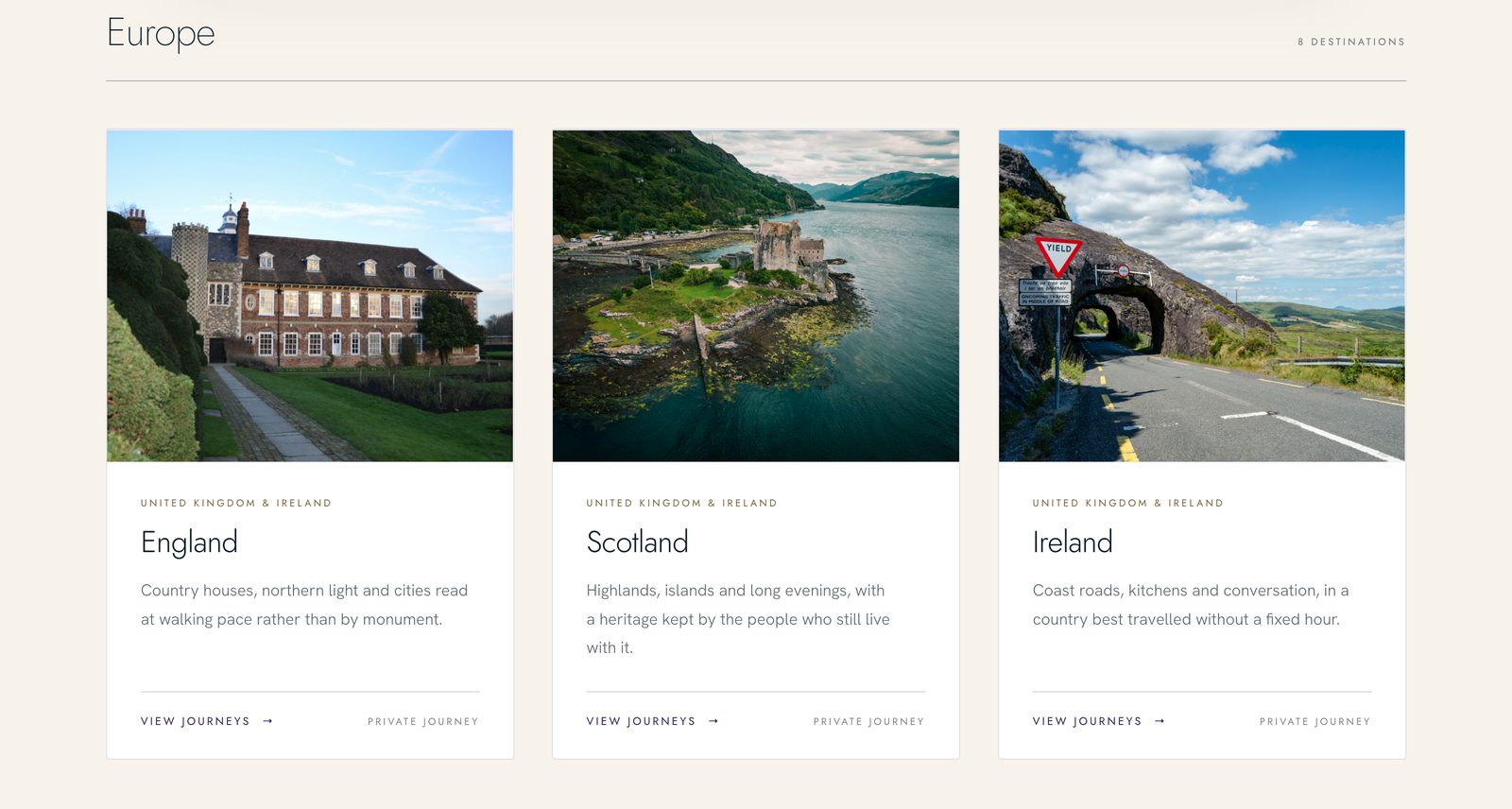
Novstige is a private travel and hospitality house. It plans journeys around culture, relationships and a real understanding of place. The brief was to create a digital experience for the brand that felt nothing like an ordinary travel agency: calm, trustworthy, exclusive, and ready to grow into tours, a journal and the rest of the business.
The concept we landed on was quiet luxury. Here’s what that meant in practice.
Not another travel agency
Most travel websites are built to sell fast. Search bars, price filters, countdown timers, “only two rooms left”. That works when the customer is shopping for a deal. It works against you when the customer is choosing someone to trust with a once-in-a-lifetime trip.
So the first decision was to remove the urgency. No pop-ups. No discount badges. No pressure. The site had to feel like the first conversation with a well-travelled friend, not a checkout.
What quiet luxury looks like on a screen
Quiet luxury is mostly about what you leave out. On Novstige that came down to a few rules:
- Space before content. Generous margins and slow pacing tell visitors nobody is in a hurry.
- Photography does the selling. Large, calm images of places, not people posing with luggage.
- One idea per screen. Each section says one thing and lets it land.
- Restraint in motion. Gentle parallax on the large heroes, nothing that jumps or flashes.
A visitor path, not a sales funnel
Instead of a funnel, the site follows a path in four steps:
Discover → Understand → Trust → Begin a conversation.
The home page is for discovering. The about page and the journal help you understand the brand. The details — the team, the way journeys are planned, one advisor from start to finish — build trust. Only then does the site ask for anything.
And when it asks, it doesn’t say “Book now”. The main call to action is “Plan your journey”. It’s an invitation, not a transaction, and it sets the tone for everything that happens after someone gets in touch.
The main call to action is never “Book now”. It’s “Plan your journey”.
Typography and colour
Type does a lot of the quiet work. Headings, labels and interface text are set in Jost, a light geometric typeface with wide, open shapes. Body text uses Hanken Grotesk, which stays clear and comfortable at reading sizes. The combination feels elegant without ever looking ornamental.
The palette is just four colours: Warm Ivory (#F7F3EA) for the page, Deep Navy (#071A2B) for text and depth, Royal Plum (#32195F) for the brand’s signature moments, and Antique Gold (#B89A63) used sparingly for small details. Four colours is enough. Every extra colour would have made the site a little louder.
Built to grow
A luxury website that looks beautiful on launch day and falls apart six months later isn’t luxury. Novstige needed to add tours, destinations and journal stories without a designer every time.
So I designed it as a system: colour tokens, a type scale and reusable components, with every piece planned for a WordPress build using Elementor Pro and ACF custom fields. A new tour is entered once and appears consistently everywhere it should. The design stays quiet, even as the content grows.
A checklist for luxury brands
- Remove every element that creates urgency. Trust doesn’t like being rushed.
- Let the photography carry the emotion, and keep the interface calm.
- Replace “Book now” with an invitation that matches your service.
- Limit your palette. Restraint reads as confidence.
- Design a system, not just pages, so the site stays elegant as it grows.
You can explore the full project in the Novstige case study.